

The agents who do well with our leads have a system.
Since 2010 we’ve had clients who succeeded with our leads and clients who didn’t. This page is what I’d recommend to someone who isn’t getting the results they want.
It covers the fundamentals. Sometimes people join our program, wing it and do their own thing, and then they have to learn. None of this helps unless you’re motivated to change what you’re doing.
It doesn’t replace our training videos. We have four to five hours of video on working leads, and I’d like every client to go through all of it. This page puts the main points in one place. If you’re considering our program, it’s the same guidance our clients get.
You should know where this comes from. When agents do well in our program, we don’t hear a lot from them. Most of the feedback I get comes from people who are struggling, so a good part of this page is about the mistakes I’ve seen and how to avoid them.
I’m not going to tell an experienced advisor how to run a practice. Every advisor and agent is different, and I’m very open to clients modifying this for their own process. The one place I’d ask you not to improvise is the first 30 seconds of the call. What follows is what I would do, based on what we’ve seen with our leads since 2010.
Scott Brooks, MBA, CFP®
Within the hour
is when I’d make the first call10–12 calls
over the first seven to ten days, at different times of day8–15 min
is about right for the first conversation3 meetings
explained on the first call, so the first one is easy to say yes toStart with what the consumer remembers
Before you dial, remember what this person did. They responded to advertising from Annuity Resources and requested a free annuity comparison report: a summary of the best annuities on the market for their state and their situation. They were told one annuity specialist would follow up within one business day to customize it. That specialist is you.
That offer resonated with them at that point in time. They were interested in it once, so they’re likely to be interested in it again. Everything you say or send in the first few contacts should line up with it: the call, the voicemail, the text and the email.
The core problem is an opening that’s different from what the consumer experienced with us and what we promised them.
Say an agent opens with, “My name is Scott Brooks, I’m with ABC Financial here in Houston. It looks like you’re interested in annuities.” All of that could be true. But nothing in it mentions Annuity Resources or the report they requested, and the lead didn’t respond to ABC Financial. They’re thinking: Who is this? Is this a cold call? I don’t want to deal with this right now. So they say “not interested” or “I already took care of it,” and you’ve been blown off.
The bigger the difference between your opening and what they remember, the bigger the problem. Most of the mistakes on this page come back to that.
If you want the detail on what consumers read and answer before they become a lead, it’s on our How We Scrub Our Leads page.
Call right away
I’d call within the hour, as soon as you possibly can. The exceptions are the larger leads, and agents who prefer to send a package to every lead before they call. I cover both further down.
Some agents worry about calling too quickly. With our leads you don’t need to. Every lead goes through our scrubbing team before it’s sold, and during business hours that usually takes a few hours. By the time the lead reaches you, the consumer has already been waiting.
The consumer was told one business day. I wouldn’t use that as your standard. We’re trying to find people in the later stages of the buying cycle, and some of them will rule annuities in or out within 24 to 48 hours of when we send you the lead. A certain percentage are already being sold an annuity by someone else in the industry, and you never know where they are in that process.
Most leads won’t decide in a day. But there’s an old saying that delay is the death of the sale, and between the internet and AI, people have more information at their fingertips than they’ve ever had. Err on the side of calling quickly.
Evenings
If a lead arrives at night and it’s still inside legal calling hours, call if you have time. If you don’t reach them, call first thing in the morning. Be aware of the calling hours and follow them for the state you’re calling into. If you’re calling into California, you go by California time.
Sundays
I would not call on a Sunday. It’s a religious day for a lot of people, and some of them get upset when they’re contacted. Monday through Saturday, call as soon as you can.
The first 30 seconds
When you join our program, we email you a word-for-word opening script. Keep it, and use it.
The opening has one job, which is to land. If there’s any miscommunication in those first seconds, they may blow you off. It follows this order:
- Who you are, and why you’re callingYour name and your firm, and in the same sentence that you’re the licensed specialist following up on the report they requested from Annuity Resources. That’s the name they know.
- What they requestedWhat we told them the annuity comparison report would show.
- Your roleYou’re the person who will be getting them that information.
- Why you have a few questionsYou don’t want to waste their time with information that doesn’t fit their situation. It should only take a few minutes.
- Ask permission“Is that OK?” or “Am I catching you at a bad time?” Use whichever one feels natural to you.
You give your own name and firm up front, so it’s clear who is calling, and you tie it to Annuity Resources and the report in the same sentence, so they know why. You aren’t our employee and the consumer hasn’t been told you are. We tell consumers that Annuity Resources works with a network of thousands of insurance agents and financial advisors nationally, and that an annuity specialist licensed in their state will contact them. We don’t tell them the specialist will be local, because some of our clients work leads in other states.
Use our opening, even if another one has worked for you
This is the number one reason people who are experienced at working leads from other companies struggle in our program. They use the script that worked somewhere else.
What works with one lead company won’t work with another, because every company promises the consumer something different. You have to be congruent with what that company told them. With our leads, that’s information on the best annuities in the market.
The opening I’d stay away from is “we were asked to give you a call.” I feel strongly that it’s the wrong way to approach our leads. It doesn’t connect to anything the person remembers, and it can come across as though it’s their lucky day because an annuity person is calling. Your first sentence should name what they requested from us.
This only applies to the opening. After those first 30 seconds, handle the call however you want.
How you sound matters as much as what you say
Keep your voice relaxed and unhurried. You don’t want to sound like a salesperson, and you don’t want any hype in it. That is a big turnoff to some of our leads and it will get you blown off. Some people decide whether they like you from the sound of your voice alone, so be deliberate about what you say and how you say it.
Getting them on the phone
Some leads are easy. In our experience, about 30% answer the phone on the first dial. More people screen their calls than they did a few years ago, so the rest take work.
Think of the follow-up as a process that runs seven to ten days. It doesn’t happen in two or three. I’d call at least 10 to 12 times over that stretch, at different times of the day. Some people take 10 or 12 attempts. A few take 15 or 20 before they answer. That isn’t most people, but it is some of them.
Don’t overdo it either. If you call someone ten times in one day, you look desperate.
The order I’d follow
- Call right away, then keep tryingSeveral attempts in the first 24 to 48 hours.
- Send the overnight packageIf you still haven’t reached them after those first attempts. On the larger leads, send it first.
- Leave a voicemailA few days after the package has arrived, if you still can’t reach them.
- Text or emailLast, once the calls, the package and the voicemail haven’t worked.
Modify this for your own process. This is what I would do.
Who should make the call
I strongly believe the advisor will normally make a better first call than an assistant. Our leads are serious. Many are already looking at proposals or products, and they have questions. If the person who calls can’t answer them, it’s off-putting, and the lead may not want to wait a week to talk to someone who can. People rule things in and out very fast today.
If you have more money than time, an assistant can work. The question is how good that assistant is on the phone with leads like ours. If they don’t have that experience, I wouldn’t have them call. There are also people in the industry you can hire to make the calls for you, and I’ve seen mixed results with that.
A very large producer writing $30 to $50 million a year is a different situation, and of course that person can have someone else call. You can also tag-team it: the assistant calls, and you step in when the assistant can’t reach the lead or has trouble with it. Try it both ways and see what works. My gut is that in most situations the advisor should make the call.
When to call
It depends on whether the person is working or retired and what their schedule looks like, which is why I’d call at different times. The peak times are mornings, the middle of the day and early evenings.
Voicemail
I still think it’s a good idea not to leave a voicemail for the first few days. I’d hold it until a few days after the package has arrived. When you do leave one, build it like the opening:
- Your name and firm, and that you’re the licensed specialist following up on the report they requested from Annuity Resources
- They recently requested a summary of the best annuities on the market
- You have a few questions so you can customize it for their situation and save them time
- Your number, and a promise that it will only take a few minutes
A voicemail you can use
“This is John Doe with [your firm]. I’m the licensed specialist following up on the report you requested from Annuity Resources, a summary of the best annuities on the market. We had a few more questions we wanted to ask, so we can customize it for your exact situation, save you time and get you the best information right away. Please give me a call back at [your number]. I promise it will only take a few minutes.”
All of that is intentional. You’re reminding them what we promised, and you’re letting them know it won’t take long. Make it easy for them to call you back.
Text and email
I don’t recommend texting or emailing a lead until it’s close to a last-ditch effort. This is a big problem in our industry. A lot of people text the lead right away because it’s easier than calling. I think that’s lazy, and you’ll get a better response talking to someone on the phone.
What we see are texts and emails that aren’t congruent with what we promised the consumer. It’s the same issue as the phone call. If there’s any inconsistency, the person will blow you off.
Agents tend to wing it and say whatever comes to mind: I’d love to talk with you about this, I’d love to send you a proposal, I’d love to come to your house, I’d love to meet with you. They’re presuming a meeting with someone they’ve never spoken to, which is just insane to me.
I call it return-free risk. You aren’t going to write an application until you’ve talked with the person on the phone, so the text or email was never going to win the case. All it can do is hurt you. If you send one at all, think through every word and make sure nothing in it works against you.
Several years ago we had a client in Atlanta who was an attorney with an estate planning designation and an insurance license. He was far more accomplished than most people in our business. Instead of calling, he emailed his leads: it looks like you’re interested in annuities, would you like to meet? All the consumer saw was a firm they had never heard of asking about annuities. It had nothing to do with what they had requested from us.
When you do text or email, structure it like the voicemail. Keep it focused on what they responded to.
The overnight package
I’m a giant believer in the overnight package, and it matters as much today as it ever has.
Nobody gets mail anymore. If a professional package shows up in someone’s mailbox, it gets prime attention. It might be the only thing they receive that day. Not everyone wants to watch a video or go through something online. A lot of people, seniors especially, still like something they can hold.
Here’s the example I usually give. You would never hold a seminar and try to book appointments in the first five minutes. People listen to you for an hour, meet you and shake your hand, and then you ask. Our leads are interested in annuities, which is why they went through our process. But they know nothing about you, and some people simply won’t book an appointment with someone they know nothing about. That’s especially true of the people with the most money.
Done properly, the package makes leads easier to get on the phone, easier to talk to and easier to book. A client of ours in North Carolina received 18 leads in his first 32 days and spoke with 16 of them. An assistant sent an overnight package to every lead before he called. He swore by it.
When to send it
Our clients do this two ways. Both work, and which one you use is your preference.
Call first, then send
Some agents would rather get the lead on the phone first, for three to five minutes, so they can customize the package for that person and ask whether there are specific questions they want addressed in the material. It’s an easy call to make, because you aren’t asking them to commit to anything. Then they send the package and call again once it has arrived. If they can’t reach the lead in the first 24 to 48 hours, they send it anyway and keep calling behind it.
Send to everyone, then call
Other agents send the package to every lead as soon as it comes in and make their call on the back end. The client in North Carolina did it this way.
Three things I’d add, whichever way you go:
- In the largest cities, send it. This is where I recommend the package most, because it’s where we see the biggest lift. These are the most competitive markets in the country, and someone in Chicago, Los Angeles or New York hears from a lot of agents.
- In smaller and rural areas, you may not need it. People there are naturally easier to deal with.
- On the larger leads, send it before you call. More on that below.
More than 90% of our leads include a mailing address.
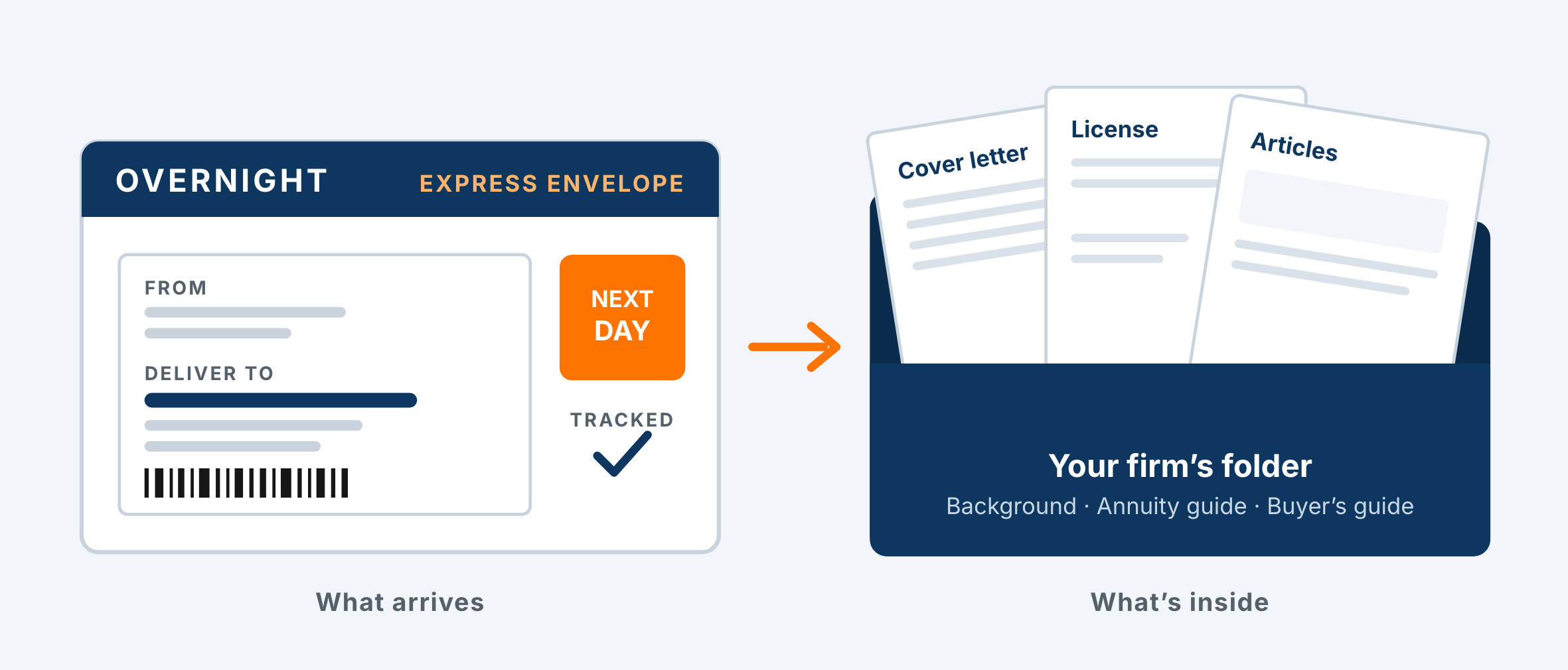
An illustration of the idea: a tracked overnight envelope, and inside it a folder with your cover letter, license copy and articles.
How to send it
If the lead is within about 100 miles, FedEx is inexpensive. I set mine up as a two-day delivery, which costs about eleven dollars on my account. When the package is going less than 100 miles it normally arrives the next day anyway, because it doesn’t have far to go. Use the tracking to confirm it arrived before you call.
The companies that send packages like this to their leads are typically very large ones. They do it for a reason. It works. What you’re doing is putting your best foot forward and presenting yourself in a professional way, and this is one way to do that.
What goes in it
Think about what a consumer would have to do to look you up and decide whether you’re credible and worth dealing with. Do that work for them. Then mix the content, so the package helps them with their decision and isn’t only about you.
Who you are
- A nice folder
- A cover letter introducing yourself
- A one-page summary of your background
- A copy of your insurance license from your state’s Department of Insurance
- Your FINRA BrokerCheck report or SEC Form ADV
- A third-party background check or ethics pledge, if you have one
- What makes your firm different, and why someone should choose it
- Your firm’s newsletter, or a few past issues
What helps them decide
- An Annuity 101 guide to the basics
- Your state Department of Insurance’s annuity buyer’s guide
- Articles on annuities from sources people trust, like Barron’s and the Wall Street Journal
- Educational pieces from third parties such as insurance companies
- Articles and information on retirement income
- If you’re an RIA, a piece from your custodian on the benefits of working with one
- A short biography or book that works as a conversation starter
A package like this tells people you take things seriously and that you’re a professional. People want to deal with professionals. Our overnight package video walks through each piece. If you only watch one of our videos, I’d make it that one. Confirm with your broker-dealer or compliance department before you send any material.
The first conversation
Our top clients don’t call a lead and wing it. They follow a structure, and this is the one we teach.
- IntroductionWho you are, what they requested and why you’re calling.
- CredibilityYour years in the business, your designations and, if you’re local, your ties to their community.
- Reasons whyWhy you need to ask a few questions before you send anything.
- QuestionsWhat they want to accomplish.
- The closeBooking the first meeting.
What goes in each part
Introduction
- Who you are
- How you got their information
- Why you’re calling
- Whether you’re catching them at a bad time
Credibility
- Your years of experience in the business
- Membership in the BBB or your Chamber of Commerce
- Your number of clients or assets under management
- Your key designations
- Your connection to their community, if you’re local
What to say, part by part
Here is the call written out. The introduction is our recommended opening. Use it as written. The rest is a starting point you can put into your own words.
Part 1 · Introduction
“This is John Doe with [your firm]. I’m the licensed specialist following up on the Annuity Resources report you requested.
The Annuity Comparison Report is a summary of the best annuities on the market for 2026: the annuities with the best guarantees, the highest potential returns and the highest guaranteed retirement income.
I am the person who will be getting you this information. Am I catching you at a bad time?”
Part 2 · Credibility
“A little about me. I’ve been helping people with their retirement for [number] years, and I’m a [designation]. [One line on your ties to their community, your BBB or Chamber membership, or how many clients you serve.]”
Part 3 · Reasons why
“Mr. Jones, there are over 2,000 annuities available today. We don’t want to waste your time and send you information that isn’t relevant to your situation or your goals. To save you time, we’ve put together a few questions so we can send you the most relevant information. It should only take a few minutes. Fair enough?”
Part 4 · Questions
Ask the questions in the list below, and let them talk. Their goals are the point of the call.
Part 5 · The close
“Here’s how I work. The first step is a 20 to 30 minute meeting where I learn more about your situation. Nothing is sold. No products are recommended and there’s no paperwork. It’s a chance for us to meet, see whether we’re a good fit, and for me to learn exactly what you want to accomplish and what you want the annuity to do. It’s also how I’ll get you the information you requested.
If it makes sense to keep going, the second meeting is where I walk you through a proposal. That takes 30 to 45 minutes. Any paperwork happens at a third meeting.
Would you rather meet in person, come to my office, or do it on Zoom?”
Questions worth asking
- What made you respond?
- Are there questions or concerns you’d like addressed in what I send you?
- Do you know what type of annuity you’re looking for?
- Are you looking at any products now?
- I see you already own an annuity. What do you like and dislike about it?
- What’s the most important thing you’re hoping to accomplish?
- Are you from ________? It’s a simple way to build rapport.
About 40–45% of our leads already own an annuity, so that fifth question comes up often. Keep the focus on their goals. What they want to accomplish is the point of the call.
If they already own an annuity
I’d drill down. How many do they own? Some of our leads already own three or four. What do they like about the ones they have, and what don’t they like? If they bought another one, would they want something similar or something different?
These people have experience, and they have their own beliefs about what’s right and what’s wrong with annuities. Find out how they think before you recommend anything. Someone could be sitting on an index annuity they were told would return 8% that has averaged 2%. You’d want to know that before you present an index annuity to that person.
Find out where they are in the process
This is really important. Are they looking at proposals and products right now? What are other people in the industry recommending to them? What are their concerns?
If they’re weighing someone else’s proposal, you can address it when you talk, and it can guide the recommendation you make. You’ll have a much better conversation about that than you will explaining what an annuity is.
Match the conversation to the person
Be aware of how knowledgeable the person is. With someone who doesn’t know what an annuity is, you can keep it basic. With someone sophisticated, you need to speak at their level.
Think of a 75-year-old physician who has bought three or four annuities, has invested for 30 years, has had an advisor or two and now manages part of the money himself. He has bought all of this before, and he sees the world through his own lens. Find out what that lens is, and use it in how you communicate with him.
Keep it to 8 to 15 minutes
Somewhere between 8 and 15 minutes is a good first call, and it depends on the person. Mirror them. If they’re a talker and they want to talk, go a little longer. If they’re direct and to the point, be direct and to the point.
The opening promises a few minutes, and the questions really do take only a few. The call runs longer only when the person wants to keep talking.
I’m not a fan of the very long call. A two-hour first call is an emotional beatdown for the prospect, and they may not want to call you back and go through it again. It also sends the message that your time isn’t valuable. A doctor doesn’t sit and talk with you for an hour. Position yourself like a professional.
When they push back
I think the bigger issue is usually how the agent responds to an objection, and less the objection itself. These are two I’d be ready for.
“I already have an advisor”
If I were working the lead, I’d act like it’s no big deal. Some agents freak out when they hear this and decide there’s no shot at the money. The reality is the agent doesn’t know anything yet.
That advisor could be their CPA. It could be someone they’re unhappy with, or someone they no longer talk to. There’s a reason they requested information from us, and I wouldn’t lose sight of that.
To me, having an advisor is a good sign. It tells you they have a history of having money and that they work with advisors. I do know it’s easier when there’s no advisor in the picture. But an advisor who manages $500,000 for someone may know nothing about the $3 million in the 401(k), or the money sitting at other institutions.
Sometimes people say it just to see how you react. Don’t overreact. Carry on as though nothing happened.
“I already bought something”
Ask a few questions before you give up on the lead:
- When did they buy it?
- Are they comfortable with it?
- Were they thinking about another annuity in addition to it?
- Were they thinking about replacing it?
They could still be in the free-look period, deciding whether to keep it. You may be able to offer an analysis of what they bought.
Booking the appointment
Don’t call a lead and immediately try to book the appointment. Speak with them first and find out their goals. Then position the appointment as the way you’ll deliver the information they requested.
If you’re getting leads on the phone and having a hard time booking them, this is the thing I’d change first.
There are three main reasons a consumer won’t book an appointment with you:
- They don’t want to be sold products at the first meeting.
- They don’t want the meeting to take a long time.
- They don’t know anything about you.
Explaining your three meetings answers the first two. The credibility you build on the call, and in the overnight package, answers the third.
Nobody likes hearing “come to my office and meet me” with no idea what happens when they get there. So on the first call, explain that you work in three meetings, what each one is for and how long it takes.
Get to know you
20 to 30 minutesYou learn their goals and what they want the annuity to do. You both see whether you’re a good fit. Nothing is sold. There are no product recommendations and no paperwork.
The proposal
30 to 45 minutesYou explain what you’re recommending and why, in person or on video.
Implementation
As neededThe paperwork to put the recommendation in place.
You have to say it out loud: the first meeting involves no paperwork and no product recommendations. That is very disarming. The person can think, I can talk to you for 20 or 30 minutes and see whether we’re a fit. That’s a low bar, and it’s easy to say yes to.
One of our clients was booking appointments with about 70% of his leads by walking them through his three meetings on the first call.
Some of our clients take paperwork on the first meeting. I’m not going to tell anyone how to run a practice. But if your appointment rate is low, try this.
Hear how one client does it
Most testimonials talk about results. Jeremy Wood, a client of ours in Salt Lake City, went further and explained in detail how he worked his leads and followed up. His explanation is quite good, and it’s worth a listen.
“Appointments on 5 of My First 7 Leads”
Jeremy Wood, Salt Lake City, UTLet them choose how to meet
This has changed since the pandemic. More of our clients now hold the first meeting on Zoom or FaceTime. I still think the customer should choose what they’re most comfortable with.
- If they want to meet face to face, meet them in person. If they’d like to come to your office, let them.
- For a busy person, like a business owner, I’d lean toward video. You can have a quick 20 to 30 minute call, nobody drives anywhere and you get down to business.
- A lead a few hours away is a video call. And a lead being local doesn’t mean you have to meet in person. Some people prefer video.
- A first meeting on video and the proposal meeting in person works well.
The more open-minded and flexible you are, the more people you’ll book. Results go sideways when you force your process on everybody. Tell someone they must meet you on Zoom and they may decide to go talk to someone at their bank who is happy to sit down with them.
Deliver the comparison they asked for
Our consumers are expecting information on the best annuities in the market. Have something you can send or show that compares the best ones you can find for them.
Some of our clients use Annuity Rate Watch, where we’ve had a corporate account since 2012. Others use CANNEX, Annuities Genius or the proposal system at their broker-dealer. Use what you have.
I’m a big believer in using proof when you sell. A lot of agents sell the same one or two products, usually index annuities, to everybody. If you tell someone one product is the best in the market and hand them a proposal from a single carrier, that’s your opinion, and people are slow to trust it. I wouldn’t trust it either.
It’s received much better when you show them third-party information that covers a lot of different products. If they can see a list that ranks 150 income annuities by the income they pay, and your recommendation holds up next to it, they’re going to feel a lot better about acting on it. You can use it alongside the proposals from the carriers.
When to deliver it
In general, send the comparison report to everyone. We promised it, and most leads will want that information at some point. If you never send it, you’ll upset a lot of them.
When you send it depends on the person. If someone is adamant about getting the information, send it right away. You don’t want to hold back something they requested, because that makes you look bad. Otherwise the first meeting or the proposal meeting is usually the natural place.
Send the material the lead values most. Some people are hardcore about products and want to look at rates. Others have more general questions about annuities and aren’t that interested in products yet. Some don’t care about the report at all and would rather have a professional recommend something for their situation. Part of your job is to find out where they are in the buying process and what they want, and then give them that. Don’t get pigeonholed into one way of doing it.
Every firm’s rules are different. Confirm with your broker-dealer or compliance department before you use any material.
The larger leads
The leads with the most assets are the hardest to book and the hardest to get to open up.
Someone considering $500,000 or more is typically a more sophisticated investor. They’ve often had a brokerage account for 20 or 30 years. They may have an advisor already. They may not like that advisor. You don’t know. What you do know is that their expectations are higher.
- Send the package first, then call. This is the one place I’d wait on the phone call. Send the package, check the tracking to make sure it arrived, and then call. If you’ve been in the industry 25 years, you want them to know that before they hear your voice. Tell your story in advance.
- Be more polished. These calls take more professionalism than most.
- Know your material. If they ask several questions and you don’t answer them well, you won’t seem credible, and the case gets a lot harder to close.
When the answer is “not yet”
“Call me in a few months, I’m not retired yet” isn’t necessarily someone blowing you off. The money may not be available yet.
Keep following up. Call them. Put them on your monthly newsletter. Keep it up until they tell you to stop. Some leads are better leads three or six months later than they are the day you receive them.
When I was with Edward Jones, we were trained that it took 15 genuine interactions with someone to move the needle and do business with them. One interaction was knocking on their door, talking for 15 minutes and leaving the monthly newsletter. Another was a phone call where you talked for 10 or 20 minutes. Another was inviting them to a small workshop at the office over coffee.
Keep in mind those were cold prospects. They weren’t leads. They were people in the community. With a quality lead you won’t need 15. You might need two or three, and you might need five or six.
A lot of agents stop after one or two interactions and assume it was a bad lead. Success is somewhere in the middle. If anyone in our program had seven to ten genuine interactions with each lead, I think their close rate would go through the roof. Be ready for the leads who want to move quickly, and keep following up with the ones who don’t.
Very few agents follow up past 60 days. The ones who do tend to do well. You’ve already paid for the lead, so why not keep working it?
A slump, then three cases in a row
One of our clients in Southern California called me in the middle of a dry spell. He hadn’t closed anything in several months. I told him he was very good at what he did and very good at following up, and that I’d bet some of the people sitting on the fence would come around.
About six weeks later he closed three cases back to back to back. Each of those clients had $1 million or more to invest. He had kept following up the whole time. This is why I tell people they need to be committed for the long term.
Know your numbers
Track these as you work our leads:
- How many leads you speak with
- How many appointments you book
- How many proposals you deliver
- How many cases you close
The numbers tell you which step to work on. A client in Ohio received 10 leads and spoke with nine of them. He booked one appointment. He wasn’t short on leads or contacts. His problem was how he asked for the meeting. A client in Kentucky took his appointment rate from 10% to 60% just by changing his process.
A client in Pennsylvania had a different problem. He received 30 leads and went on eight appointments. All eight had money and all eight were interested in annuities. He closed none of them. That’s unusual, because most of our clients do well once they’re in front of someone, and it pointed to his sales approach.
As a general observation, clients who do well book appointments with 30% to 70% of our leads, and the most common trait of people who struggle is an appointment rate under 20%. There’s more on results in our Common Questions.
What 20 leads can look like
Here’s the arithmetic on a 20-lead test, using what we’ve seen historically. Twenty leads at $300 is $6,000.
| Producer | Historical close rate | Cases from 20 leads | Premium at a $250,000 average case |
|---|---|---|---|
| Strong | 1 in 3 to 4 | 5 to 7 | $1,250,000 to $1,750,000 |
| Average | 1 in 5 to 10 | 2 to 4 | $500,000 to $1,000,000 |
| Below average | 1 in 11 to 20 | 1 to 2 | $250,000 to $500,000 |
Apply your own commission rate to the premium and compare it with the $6,000. Our average case is about $250,000, and it varies a lot by producer and market.
Where you work changes these numbers a lot. In rural areas and smaller markets, close rates run much higher than they do in a large city, and we’ve had clients close one out of every two or three leads. In the largest cities the rate is lower and the cases are larger.
This is an illustration built from historical observations. It isn’t a guarantee. Your results depend on your follow-up, your market and your sales ability, and sales don’t arrive evenly. That’s why I tell people to judge the program on 10 to 20 leads and never on three.
Your market changes the math
I wouldn’t be rigid about benchmarks, because markets are different.
Large, wealthy metro areas
Expect lower numbers. People are harder to reach and slower to call back, and a client in a tough market might close one lead in ten. The cases are much bigger. In markets like Southern California and Seattle we’ve had clients average $500,000 or more per case, which is more than double what we see in most of the country.
The Midwest and smaller markets
People are generally easier to get on the phone, easier to book and easier to close. There isn’t as much money. A typical case might be $200,000 to $250,000.
Case size also depends on the agent. How much of a client’s assets an agent recommends placing in an annuity varies a lot from one agent to the next.
You need a different mindset in Los Angeles than you do in Ohio or Nebraska. The bigger cases can more than make up for the lower percentages.
If you come from seminars
Seminar producers sometimes struggle when they start with us, because they treat our leads like people who just sat through their hour-long presentation.
It’s close to the opposite situation. Someone at a seminar has met you and listened to you, and may have no interest in annuities at all. Our leads are interested in annuities specifically, and they know nothing about you. Your job is to build rapport and book the meeting with someone who already wants the product. It’s very difficult to change someone’s mind, and the convincing business is not a fun one to be in.
A client of ours in Southern California put it this way:
“Scott, when I did seminars we would get 25 to 35 buying units to attend, but only three or four were good candidates and wanted annuities. Your leads are like those three or four people.”
What our top clients have in common
I’m not going to tell you our client base is full of mediocre producers. It isn’t. Almost all of the clients who do well with us are good to great producers, writing somewhere between $5 million and $50 million a year in premium.
- They have established practices. More staff, better sales ability and a budget. Many of them receive at least five to ten leads a month. Most of our top clients spend roughly $10,000 to $40,000 a year on our leads, depending on how many we can send in their territory.
- Many of them buy from more than one company. Not all, but many of our top clients also buy leads from our competitors, because we can’t supply all the leads they want. I keep a narrow focus on finding the most qualified prospects, and there are only so many of those people in each market. Clients in rural areas are more or less forced to work with several companies, because no vendor can send them enough.
- They don’t freak out about any one lead. When they go two, three or four leads without a sale, they keep working, because the law of averages works out for them over time.
- They’re committed to the long-term result. I think this is significantly undervalued in our industry.
We have a client in a rural area, in a state without a lot of money, who has been one of our most productive clients for many years running. He covers about a 200-mile radius, so he reaches more people than someone covering 60 miles. He spends less with us than most of our top clients do. His close rate is much higher than most, and he has written some large cases. A few years ago he told me he had converted every appointment he had that year except one. That person had dementia, and he chose not to take on the business. Our leads tend to be the people in an area who do have money. He is very good at selling. Even he goes through stretches where he doesn’t close two, three or four leads in a row. Then he closes two or three in a row.
We’ve worked with plenty of people who are newer to the business. The difficulty for them is usually getting mentally used to spending the money. Established producers with successful businesses are used to spending on marketing and leaving that spending running. Someone newer has never done it before.
It’s a skill. You have to get used to spending the money and not seeing success right away. Someone can come out of a wirehouse having never paid for marketing. When they go out on their own, their commission might triple or quadruple, and they still have to get used to spending it. The good news is that it’s like lifting weights. It’s a muscle you can build.
A big producer I know recommends putting about 15% of the top-line revenue you want to reach into marketing, and somewhere between 12% and 25%. His view is that if you do that, the revenue will come, and if you don’t, it won’t. Getting used to spending on a regular basis takes time.
The emotional side
A lot of the success in working leads, and in staying with a program for the long term, is emotional.
We’ve worked with agents who are very good at selling and treat it like a game to close everyone they possibly can. One client in a large metro market closed about five out of seven leads, which is really hard to do in a market that size. It was one of the best returns I’ve ever seen. The two he didn’t close bothered him much more than the five he did, and he ended up stopping the program.
In my opinion he focused on the wrong thing. He was so set on avoiding the failures that he lost sight of the success he’d had. That’s something to avoid.
Who shouldn’t buy our leads
People who expect something miraculous from the first two or three leads.
We say a fair test is 10 to 20 leads, and here’s the reason. Looking back over 16 years, the people most likely to lose money with us stopped before 10 or 15 leads. The ones who quit after two, three or four are the most likely of all. A decent salesperson who works 15 leads is much more likely to earn a positive return, because the law of averages has had time to work.
You could write a large case on lead one. You could also strike out on the first six or seven, close leads nine and twelve, and come out well ahead.
A lot of agents have had a bad experience with another lead company, and they carry it into the next one. They’re worried it will happen again. I understand that. I’ve talked with more than 10,000 agents and I’ve heard every story. But you have to put your best foot forward and believe it can work. If you don’t believe it will work, it won’t.
If you’d like to hear from clients in their own words, they’re on our testimonials page.
The one thing to take from this page
Get organized. Have a system for how you follow up, and make it deliberate and well thought out.
An agent told me once that his number one mistake, after a year of working our leads, was winging it. He had been in the industry 30 years and figured that would be enough to get results.
It’s like everything else we do. Proper preparation prevents poor performance.
Our training videos
The videos go deeper than this page can, and I’d watch all of them. Some were recorded years ago. Where a detail differs from what you’ve read here, go with this page.
If you only watch one, watch the overnight package video. It’s our most popular, and I think it’s the one that makes the biggest difference. The top producers video is the other one clients have gone back to most over the years.
- Overnight Package: How to Improve Your Contact and Close Rate With Shock & Awe Marketing PackagesStart here. Our most popular video, and it covers everything that goes in the package.
- How Top Producers Work High-Quality Leads1 hr 5 min. How our best clients structure their follow-up and their calls.
- The 8 Biggest Mistakes Financial Advisors Make When Working Leads
- 9 Case Studies From the Trenches: What Does and Does Not Work When Working Annuity Leads
- 7 Strategies to Maximize Your Return on Investment When Working Annuity Leads
- Annuity Lead Generation Best Practices
Questions about working our leads?
Whether you’re a client or you’re considering our program, call us. We’ll answer your questions and tell you whether your territory is open.
Leads are opportunities and are not guaranteed appointments, applications or sales. The client results described on this page are individual examples. Results vary by producer and market. You are responsible for your own compliance when you contact a lead, including your firm’s and your state’s rules.
More Resources
About Our Lead Program
- Common Questions About Our Annuity Leads: pricing, territories, billing, refunds and how the program works.
- How We Scrub Our Leads: what our team checks before a lead ever reaches you, and why more than half never do.
- Working Our Annuity Leads: the opening script, the overnight package and the follow-up process our best clients use.
- Testimonials From Our Clients: audio testimonials from agents and advisors who use our leads.
- Free Training Video: how top producers work high-quality annuity leads.
- About Us: who we are and how we’ve run the business since 2010.
Articles
- Why Good Annuity Leads Look Bad: the five signs that fool agents into giving up on good prospects too soon.
- Why Some Agents Make Money With Annuity Leads and Others Don’t: what our most successful clients do differently.
- The 12 Biggest Mistakes Agents Make When Buying Annuity Leads: what to avoid before you spend a dollar.
- Will Annuity Leads Work in My Area? Rural vs. Big City Markets: how your market changes lead flow, case size and close rates.
- What I’ve Learned Spending Eight Figures Advertising Annuities: 16 years of lessons from the advertising side.
- Founder Interview: The Story Behind TheAnnuityLeads.com: how the company started and why it works the way it does.
- My Clients Were My Greatest Teachers: what 3,000 financial professionals taught me about business, people and myself.